I believe natural language is becoming the primary interface for doing science.
Scientists can increasingly describe the analysis they want to perform in the same language they use to think, discuss and write about their research, with agentic AI translating those instructions into computational workflows.
For decades, turning a scientific idea into a computational analysis has required expressing it through the technical syntax of programming languages and software APIs. That syntax was never the science itself: it was the interface between the scientist’s ideas and the computer carrying them out. Removing that barrier lets scientists spend less time translating their thinking into code and more time thinking about the scientific questions they want to answer.
My aim is to make natural language the primary way scientists turn ideas into research, with AI expanding what they can do while preserving their control and autonomy. Natural language provides the interface; AI provides the capability; the scientist provides the understanding, direction and judgement.
Scientific assistants
I am putting this vision into practice by redesigning my scientific software around natural language input.
The PyAutoLens Assistant lets anyone investigate gravitational lenses through natural language, even if they are new to the science or software. You describe what you want to understand, and an AI coding agent turns that request into an interactive analysis where you can inspect the data, ask questions, change the model and learn as you go.
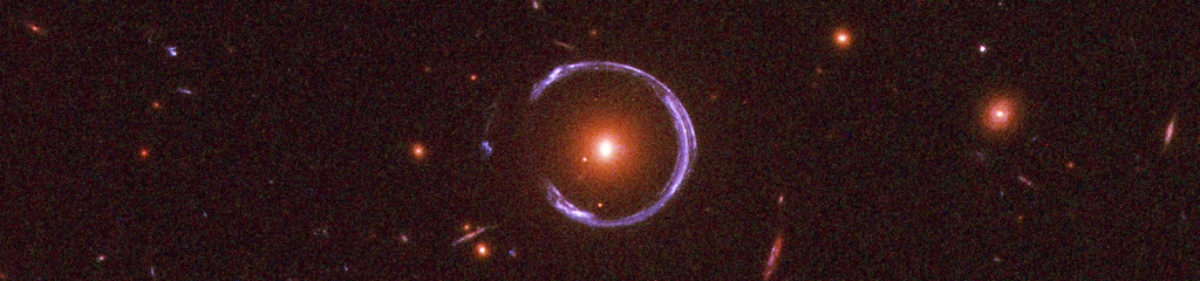
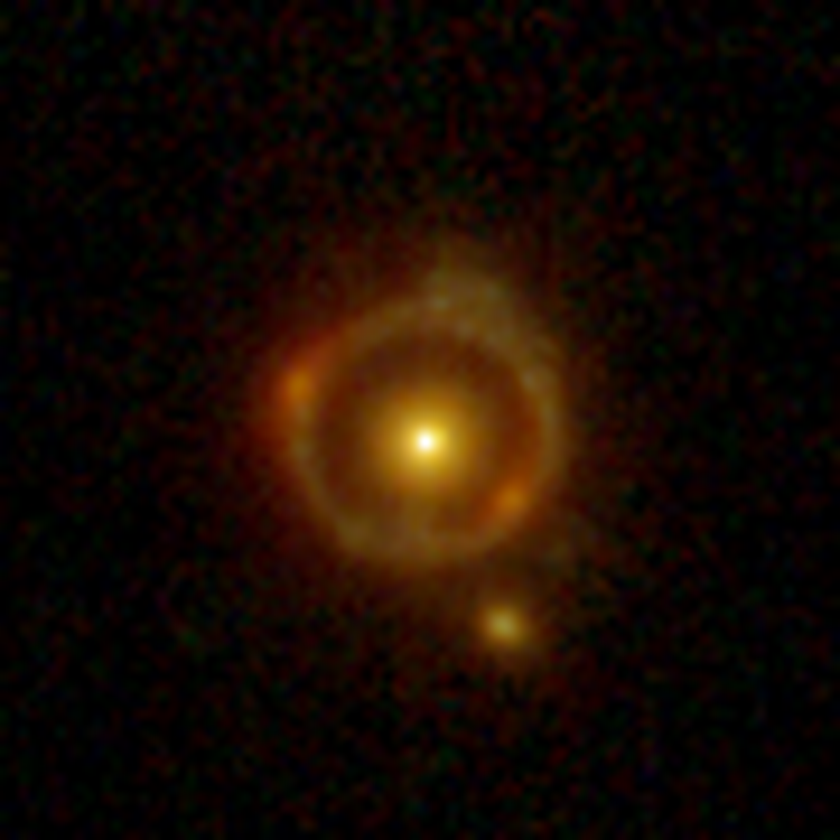
You can weigh a galaxy yourself. The COSMOS-Web Ring is one of the most striking gravitational lenses the James Webb Space Telescope has found. It was discovered in the COSMOS-Web survey by Mercier et al. (2024) and is part of the COSMOS-Web Lens Survey (COWLS), which I lead. A massive galaxy at a redshift of about 2 bends the light of a more distant galaxy, at a redshift of about 5.1, into an almost perfect ring. JWST imaged it in four colours, and because gravitational lensing bends every colour of light in the same way, the ring looks the same in all of them. With the assistant, you can look at the JWST image, fit a lens model in a few minutes on a laptop and measure the mass inside the ring: a few hundred billion times the mass of the Sun. You do not need to know all the physics or write the code beforehand: you can build that understanding through the analysis itself.
The assistant starts by asking who you are, whether a curious reader, a student or a researcher, and pitches the walkthrough to your background.
Try it yourself. Open Claude Code, Codex or another supported AI coding agent and start with this prompt; the agent installs the assistant itself:
I want to use the PyAutoLens Assistant: https://github.com/PyAutoLabs/autolens_assistant First clone that repository, cd into it and follow its AGENTS.md.

I'd like to understand how gravitational lensing works using the JWST image of the COSMOS-Web Ring that ships with the assistant. Show me the picture, explain what we are looking at, and walk me through fitting a lens model so we can measure the mass inside the ring and see how well the model reproduces the observations. Pitch it at my level: ask me what my background is first. Explain what we are doing as we go, and let me ask questions or change the analysis along the way.
The COSMOS-Web Ring (COSJ100024+015334), JWST NIRCam colour image from the COSMOS-Web Lens Survey (COWLS). Credit: COWLS / Nightingale et al. (2025); discovered by Mercier et al. (2024).
Open the same analysis as a Google Colab notebook, with more explanation. It is recommended if you are learning PyAutoLens and want to see the code.
That is what excites me about natural language as an interface to science: you can go from asking “How do we weigh a galaxy?” to working with real observations and measuring its mass yourself. You stay involved throughout, questioning assumptions, exploring results and deciding what to investigate next.
Learning the science
Being able to measure a galaxy’s mass through natural language does not remove the need to understand the science behind that measurement. To direct an analysis well, you still need to understand the physics, the modelling assumptions and how uncertainty is quantified. I design my natural-language software with that in mind: easier access to sophisticated analysis should make scientific understanding more important, not less.
This is why I am building education directly into my natural-language software ecosystem. The HowToLens Lectures teach gravitational lensing from first principles, pairing explanations with Python that readers can run and explore. The PyAutoLens Assistant can also act as a teacher, explaining concepts, answering questions and helping users understand the analysis they are directing.
The aim is that a researcher first develops the knowledge needed to understand and direct an analysis, and can then use natural language to put that knowledge into practice. You can try the first HowToLens science lecture in Google Colab in your browser, where eligible users can also use Colab’s Gemini integration to ask questions about the science and code as they work through it.
Building software through natural language
I also use natural language to develop the software itself. Through PyAutoScientist, I describe scientific and software requirements in plain English, with AI coding agents helping plan, implement, test and document the changes. I set the direction and review the work, while the code remains open and available to inspect. This connects how I build scientific tools with how researchers learn to use them and carry out science.
Teaching natural-language science
I teach these ideas through my workshop Using Natural Language to Do Science: How Agentic AI Empowers Astronomers. It shows researchers how natural language can become the starting point for scientific work: understanding unfamiliar software, developing analyses, running and debugging code, interrogating results and refining scientific questions with an AI coding assistant.
The message is the same as for my software: the scientist leads the research, while AI removes technical friction between an idea and putting it into practice. The aim is to help researchers work this way confidently while retaining the scientific understanding, judgement and autonomy needed to direct the science.
View the workshop slides online or download them as PowerPoint. This version focuses on PyAutoLens.