Hi, I’m James Nightingale. I’m an observational cosmologist and Ernest Rutherford Fellow at Newcastle University, and I spend my days weighing galaxies with light that gravity has bent.
I believe natural language is becoming the primary interface for doing science.
To show you what I mean: do you want to measure the mass of a galaxy?
Open Claude Code, Codex or another AI coding agent and paste this (the agent installs the PyAutoLens Assistant itself):
I want to use the PyAutoLens Assistant: https://github.com/PyAutoLabs/autolens_assistant First clone that repository, cd into it and follow its AGENTS.md.

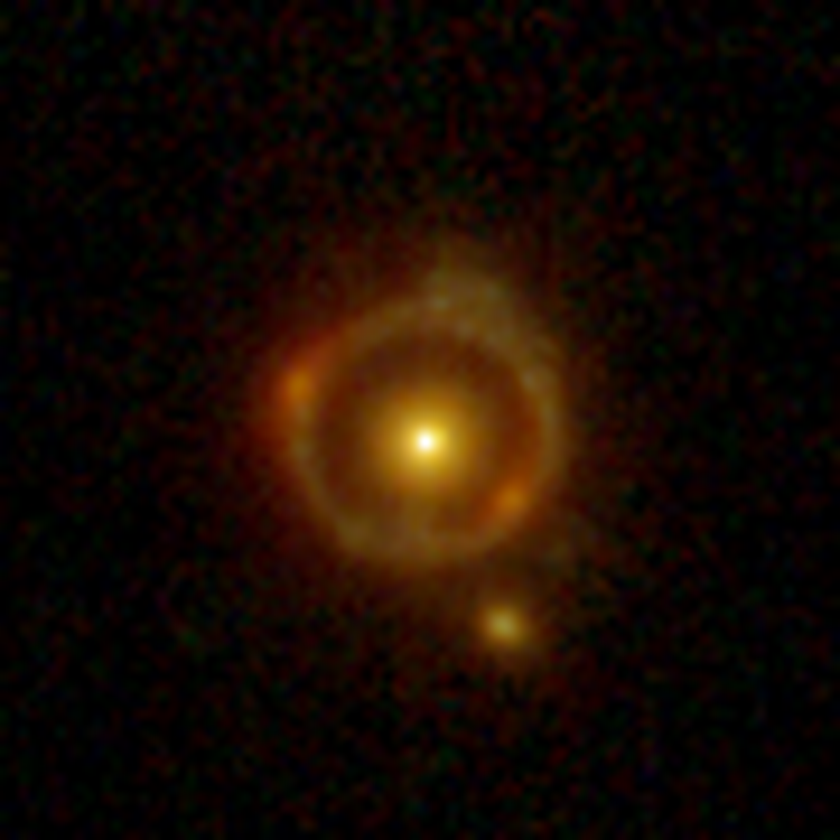
I'd like to understand how gravitational lensing works using the JWST image of the COSMOS-Web Ring that ships with the assistant. Show me the picture, explain what we are looking at, and walk me through fitting a lens model so we can measure the mass inside the ring and see how well the model reproduces the observations. Pitch it at my level: ask me what my background is first. Explain what we are doing as we go, and let me ask questions or change the analysis along the way.
In a few minutes on a laptop, you’ll have weighed a galaxy whose light left it over ten billion years ago: a few hundred billion Suns inside the ring. You don’t need to know the physics or the code first. The assistant asks your background and teaches you as you go.
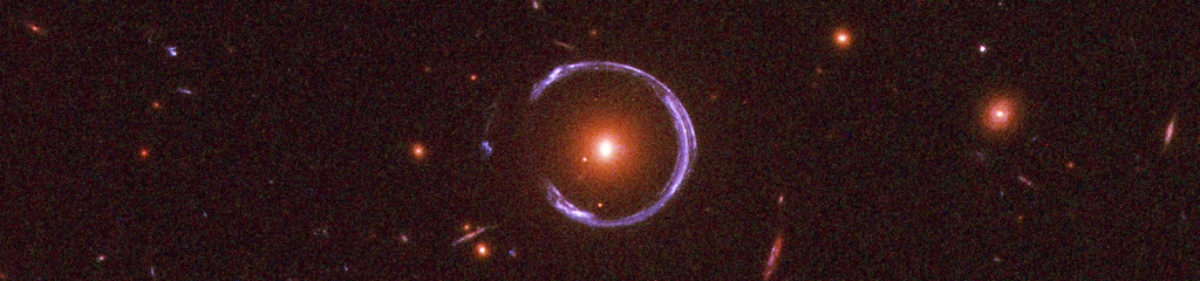
The COSMOS-Web Ring (COSJ100024+015334), JWST NIRCam colour image from the COSMOS-Web Lens Survey (COWLS). Credit: COWLS / Nightingale et al. (2025); discovered by Mercier et al. (2024).
Open the same analysis as a Google Colab notebook, with more explanation. It is recommended if you are learning PyAutoLens and want to see the code.
The tools behind it
- PyAutoLens: the open-source lens-modelling software I lead.
- PyAutoLens Assistant: natural-language lens analysis.
- HowToLens: learn the science from first principles (try it in Colab).
- COWLS: the COSMOS-Web Lens Survey I lead, where this ring comes from.
More
- Natural Language & AI: the vision, how I build software this way, and my workshop.
- Cosmology: lensing to study the most massive black holes, the smallest dark matter clumps and the most distant Universe.
- Euclid: strong lensing and CCD radiation-damage correction for Euclid.
- Cancer: my statistics methods (PyAutoFit) applied to cancer treatment.
CV · Publications · Talks · GitHub · ORCID